Technorati:
Monday, July 21, 2008
Olso story continues
A few days ago an article appeared on eWeek titled ‘Oslo: Road to Microsoft’s Cloud’. This article displays a nice outline, where Oslo is heading. With PDC coming in October Oslo will also get its fair share of attention. I for one hope to be able to go there together with my colleague Edward Bakker from Inter Access. If you are interested you should look at the session agenda. For now I will focus on my coming summer holiday, a couple of weeks with the family visiting the Czech republic. After that I will continue with my HPL environment and finish writing some articles.
Technorati:
Microsoft OSLO
Technorati:
Thursday, July 10, 2008
BizTalk Best Practices Analyzer
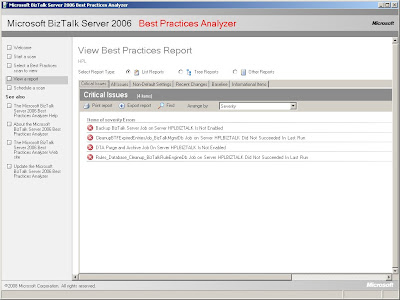
One of my High Performance Learning Environment post reader gave me a hint to have a look at BizTalk Best Practices Analyzer. In past I have used this tool and I forgot that it could be useful to apply on the environment I created. The BizTalk Server 2006 Best Practices Analyzer (version V1.1)performs configuration-level verification by reading and reporting only. The Best Practices Analyzer gathers data from different information sources, such as Windows Management Instrumentation (WMI) classes, SQL Server databases, and registry entries. The Best Practices Analyzer uses the data to evaluate the deployment configuration. The Best Practices Analyzer does not modify any system settings, and is not a self-tuning tool. I downloaded it and gave it a spin inside my environment.

It came up with some critical issues; which were resolved by enabling first of all SQL Server agent (so jobs can run) and enable jobs. Second thing was to change steps inside the job ‘Backup BizTalk Server’ because of the following error:
BackupDiskFile::CreateMedia: Backup device 'C:\Program Files\Microsoft SQL Server\MSSQL.1\MSSQL\Backup\\HPLBIZTALK_BizTalkDTADb_Full_BTS_2008_07_10_11_10_40_157.bak' failed to create. Operating system error 123(The filename, directory name, or volume label syntax is incorrect.).
I fixed this by change two steps called BackupFull and MarkAndBackupLog, both containing TSQL Script commands.
exec [dbo].[sp_BackupAllFull_Schedule] 'd' /* Frequency */, 'BTS' /* Name */, '' /* location of backup files */
Into:
exec [dbo].[sp_BackupAllFull_Schedule] 'd' /* Frequency */, 'BTS' /* Name */, 'BizTalkDTADb_Bak' /* location of backup files */
exec [dbo].[sp_MarkAll] 'BTS' /* Log mark name */, '' /* location of backup files */
Into:
exec [dbo].[sp_MarkAll] 'BTS' /* Log mark name */, '' /* location of backup files */
Correcting this job and running the others resulted in only one critical error:
Error DTA Purge and Archive Job on Server HPLBIZTALK Did Not Succeeded In Last Run The SQL job DTA Purge and Archive (BizTalkDTADb) need to run successfully on your DTA database server HPLBIZTALK. Contact your SQL administrator to troubleshoot the problem.Do not rename this SQL job as this is not supported.
So I looked at TSQL Command:
exec dtasp_BackupAndPurgeTrackingDatabase
0, --@nLiveHours tinyint, --Any completed instance older than the live hours +live days
1, --@nLiveDays tinyint = 0, --will be deleted along with all associated data
30, --@nHardDeleteDays tinyint = 0, --all data older than this will be deleted.
null, --@nvcFolder nvarchar(1024) = null, --folder for backup files
null, --@nvcValidatingServer sysname = null,
0 --@fForceBackup int = 0 –
Googled around and I tackled this problem through a post by Saravana Kumar, where he states to change the above script into:
declare @dtLastBackup datetime set @dtLastBackup = GetUTCDate() exec dtasp_PurgeTrackingDatabase 1, 0, 1, @dtLastBackup
And yes this job works too, so now I am rid of all my critical issues. I must say using this tool is very useful after installation and configuration of your BizTalk environment. This should definitely be a step during your rollout of BizTalk inside an organization.
Technorati:
BizTalk
BizTalk Server 2006 R2
BizTalk Best Practices Analyzer

It came up with some critical issues; which were resolved by enabling first of all SQL Server agent (so jobs can run) and enable jobs. Second thing was to change steps inside the job ‘Backup BizTalk Server’ because of the following error:
BackupDiskFile::CreateMedia: Backup device 'C:\Program Files\Microsoft SQL Server\MSSQL.1\MSSQL\Backup\
I fixed this by change two steps called BackupFull and MarkAndBackupLog, both containing TSQL Script commands.
exec [dbo].[sp_BackupAllFull_Schedule] 'd' /* Frequency */, 'BTS' /* Name */, '
Into:
exec [dbo].[sp_BackupAllFull_Schedule] 'd' /* Frequency */, 'BTS' /* Name */, 'BizTalkDTADb_Bak' /* location of backup files */
exec [dbo].[sp_MarkAll] 'BTS' /* Log mark name */, '
Into:
exec [dbo].[sp_MarkAll] 'BTS' /* Log mark name */, '
Correcting this job and running the others resulted in only one critical error:
Error DTA Purge and Archive Job on Server HPLBIZTALK Did Not Succeeded In Last Run The SQL job DTA Purge and Archive (BizTalkDTADb) need to run successfully on your DTA database server HPLBIZTALK. Contact your SQL administrator to troubleshoot the problem.Do not rename this SQL job as this is not supported.
So I looked at TSQL Command:
exec dtasp_BackupAndPurgeTrackingDatabase
0, --@nLiveHours tinyint, --Any completed instance older than the live hours +live days
1, --@nLiveDays tinyint = 0, --will be deleted along with all associated data
30, --@nHardDeleteDays tinyint = 0, --all data older than this will be deleted.
null, --@nvcFolder nvarchar(1024) = null, --folder for backup files
null, --@nvcValidatingServer sysname = null,
0 --@fForceBackup int = 0 –
Googled around and I tackled this problem through a post by Saravana Kumar, where he states to change the above script into:
declare @dtLastBackup datetime set @dtLastBackup = GetUTCDate() exec dtasp_PurgeTrackingDatabase 1, 0, 1, @dtLastBackup
And yes this job works too, so now I am rid of all my critical issues. I must say using this tool is very useful after installation and configuration of your BizTalk environment. This should definitely be a step during your rollout of BizTalk inside an organization.
Technorati:
Monday, July 07, 2008
High Performance Learning Environment for BizTalk Part III - Tooling
First step for High Performance Learning environment lasted two days in total, setting up OS, AD, SQL Server, BizTalk Server en SCOM. Next step is install tooling, one is of course VS 2005 to be able to develop BizTalk artifacts like orchestrations, pipelines, maps and schema’s. For alignment of BizTalk Server R2 to align with VS 2008 you have to wait until R3, that integrates with not only VS 2008 but also SQL Server 2008 and Windows OS 2008. Besides VS 2005 the following tooling from CodePlex and other resources are installed in the environment:
* BizTalk Solution Factory;
* Pipeline Testing Tool;
* BizUnit;
* BizUnitDesigner;
* Enterprise Library 3.1 May 2007;
* Log4Net;
* Code Style Enforcer;
* BizTalk Deployment Framework;
* Orchestration Profiler;
* MapCop;
* BizTalk Server Pattern Wizard.
This tooling will be helpful during the following steps in High Performance Learning Developing Solutions, testing and deploying. Most of you people will found their way in CodePlex, so there is not much I can add here. In some of my previous posts I have mention and explained some the tools mentioned above.
Technorati:
BizTalk
BizTalk Server 2006 R2
* BizTalk Solution Factory;
* Pipeline Testing Tool;
* BizUnit;
* BizUnitDesigner;
* Enterprise Library 3.1 May 2007;
* Log4Net;
* Code Style Enforcer;
* BizTalk Deployment Framework;
* Orchestration Profiler;
* MapCop;
* BizTalk Server Pattern Wizard.
This tooling will be helpful during the following steps in High Performance Learning Developing Solutions, testing and deploying. Most of you people will found their way in CodePlex, so there is not much I can add here. In some of my previous posts I have mention and explained some the tools mentioned above.
Technorati:
Friday, July 04, 2008
High Performance Learning Environment for BizTalk Part IIa - Configuration SCOM
Last bit of my High Performance Learning Environment was configuring System Center Operation Manager (SCOM). At least I installed operation manager and in my menubar I have operation manager and access to command shell, operation console and web console. Screen shot of web console can be seen below.

In setup of SCOM you can find installation documentation, it also tells you how to deploy SCOM on a single computer using setup wizard. And that is what I have done, but I have configured SCOM to do something like monitoring BizTalk. So next step is getting the BizTalk Management Pack for SCOM, see also my previous post about BizTalk and SCOM. I installed management pack, which seem to go smoothly and then I imported the pack inside SCOM. Through application console inside administration you can import management pack. You will have to import Microsoft.BizTalk.Server.2006.Library 6.0.6278.16 and Microsoft.BizTalk.Server.2006.Discovery 6.0.6278.16 first, because BizTalk Monitoring Management Pack depends on it. That is you have to start with the library, then discovery and finally monitoring.

Next step is creating a new management group through authoring inside SCOM console. You need this, before you can install agent that is going to do monitoring. To install an agent I need to specify management group information (specify manually the Management Group for which this agent will monitor). I specified the group created before in SCOM console under authoring. Once installed I still did not see any monitoring going on and I then found out that Health Service was not running.
Error: The Health Service could not log on the RunAs account HPL\SQLServerInstance for management group HPL Admins because it has not been granted the 'Log On Locally' right.
I corrected the error by assigning proper rights for the account. For monitoring I added a monitor through Authoring Pane, monitors create new monitor (unit monitor). Then selected type of monitor : Windows Services - Basic Service Monitor. Next gave it an name and selected through select BizTalk Group and then clicked create. Through Monitoring pane I inside BizTalk Server 2006 (due to management pack is there now) ---> Core ---> BizTalk 2006 State View is show BizTalk is Healthy.

I hope this post is useful for you to configure SCOM to monitor BizTalk, at least a part of it. I do know if I did configuration steps in the right order, but I have got it working so far.
Technorati:
BizTalk Server 2006 R2
BizTalk
SCOM 2007

In setup of SCOM you can find installation documentation, it also tells you how to deploy SCOM on a single computer using setup wizard. And that is what I have done, but I have configured SCOM to do something like monitoring BizTalk. So next step is getting the BizTalk Management Pack for SCOM, see also my previous post about BizTalk and SCOM. I installed management pack, which seem to go smoothly and then I imported the pack inside SCOM. Through application console inside administration you can import management pack. You will have to import Microsoft.BizTalk.Server.2006.Library 6.0.6278.16 and Microsoft.BizTalk.Server.2006.Discovery 6.0.6278.16 first, because BizTalk Monitoring Management Pack depends on it. That is you have to start with the library, then discovery and finally monitoring.

Next step is creating a new management group through authoring inside SCOM console. You need this, before you can install agent that is going to do monitoring. To install an agent I need to specify management group information (specify manually the Management Group for which this agent will monitor). I specified the group created before in SCOM console under authoring. Once installed I still did not see any monitoring going on and I then found out that Health Service was not running.
Error: The Health Service could not log on the RunAs account HPL\SQLServerInstance for management group HPL Admins because it has not been granted the 'Log On Locally' right.
I corrected the error by assigning proper rights for the account. For monitoring I added a monitor through Authoring Pane, monitors create new monitor (unit monitor). Then selected type of monitor : Windows Services - Basic Service Monitor. Next gave it an name and selected through select BizTalk Group and then clicked create. Through Monitoring pane I inside BizTalk Server 2006 (due to management pack is there now) ---> Core ---> BizTalk 2006 State View is show BizTalk is Healthy.

I hope this post is useful for you to configure SCOM to monitor BizTalk, at least a part of it. I do know if I did configuration steps in the right order, but I have got it working so far.
Technorati:
Wednesday, July 02, 2008
High Performance Learning Environment for BizTalk Part II - Install & Configuration
In this part I will lay out what I have done to create the environment.Setting up VPC one will need the following Iso's or DVD's:
VPC:
* Microsoft Virtual PC 6.0.156.0 (2007)
OS:
* en_win_srv_2003_r2_enterprise_with_sp2_cd1_X13-05460
BizTalk:
* en_biztalk_server_2006_r2_developer_x86_x64_dvd_X14-00846
SCOM:
* en_scom_2007_cd_X13-72525
SQL Server 2005:
* en_sql_2005_ent_x86_dvd
VS 2005:
* en_vs_2005_pro_dvd
At least these are one I have used. One will obtain these through an MSDN subscription or maybe trail editions. First step to setting up the environment is installing OS on VPC. This is pretty straigh forward, in one of my previous post I have outlined this before. Same account for installing SQL Server, Visual Studio 2005 and BizTalk Server 2006 R2. Note here though after installing OS do not forget Virtual Machine add-ons and apply patches. If cannot reach internet through VPC look here. (http://blogs.msdn.com/virtual_pc_guy/archive/2005/01/06/347965.aspx)Patching OS before continuing installing other Products one probably has to install the following list of patches (37):
* Security Update for Windows Server 2003 (KB951698)
* Cumulative Security Update for Internet Explorer 6 for Windows Server 2003 (KB950759)
* Windows Malicious Software Removal Tool - June 2008 (KB890830)
* Cumulative Security Update for ActiveX Killbits for Windows Server 2003 (KB950760)
* Security Update for Windows Server 2003 (KB950762)
* Security Update for Windows Server 2003 (KB944338)
* Security Update for Windows Server 2003 (KB941693)
* Security Update for Windows Server 2003 (KB945553)
* Security Update for Windows Server 2003 (KB948590)
* Update for Windows Server 2003 (KB948496)
* Security Update for Windows Server 2003 (KB946026)
* Security Update for Windows Server 2003 (KB943055)
* Security Update for Windows Server 2003 (KB941644)
* Security Update for Windows Server 2003 (KB943485)
* Update for Windows Server 2003 (KB942763)
* Security Update for Windows Server 2003 (KB944653)
* Security Update for Windows Server 2003 (KB941569)
* Update for Windows Server 2003 (KB936357)
* Windows Internet Explorer 7 for Windows Server 2003
* Security Update for Windows Server 2003 (KB943460)
* Security Update for Windows Server 2003 (KB933729)
* Security Update for Outlook Express for Windows Server 2003 (KB941202)
* Security Update for Windows Server 2003 (KB936021)
* Security Update for Microsoft .NET Framework, Version 1.1 Service Pack 1 (KB933854)
* Security Update for Windows Server 2003 (KB936782)
* Security Update for Windows Server 2003 (KB938127)
* Security Update for Windows Media Player 6.4 (KB925398)
* Security Update for Windows Server 2003 (KB926122)
* Security Update for Windows Server 2003 (KB935839)
* Security Update for Windows Server 2003 (KB924667)
* Cumulative Security Update for Outlook Express for Windows Server 2003 (KB929123)
* Security Update for Windows Server 2003 (KB935840)
* Update for Windows Server 2003 (KB927891)
* Security Update for Windows Server 2003 (KB930178)
* Security Update for Windows Server 2003 (KB931784)
* Security Update for Windows Server 2003 (KB932168)
* Security Update for Windows Server 2003 (KB925902)
Server Roles I added to OS are:
* AD (being domain controller)
Full DNS : HPL.IA.COM
Domain NetBios name : HPL
DNS Registration Diagnostic (Diagnostic Failed) option Install/Configure the DNS server on thos computer, and set this computer to use this DNS Server as its perferred DNS Server (oke watch out here permission compatible only with win 2000 or win 2003 os Option)
Configure this server as the first domain controller in a new forest of domain trees.
The new domain name is HPL.IA.COM. This is also the name of the new forest.
The NetBIOS name of the domain is HPL
Database folder: C:\WINDOWS\NTDS
Log file folder: C:\WINDOWS\NTDS
SYSVOL folder: C:\WINDOWS\SYSVOL
The DNS service will be installed and configured on this computer. This computer will be configured to use this DNS server as its preferred DNS server.
The password of the new domain administrator will be the same as the password of the administrator of this computer.
Assign static IP address
Next role is
* Application Server (IIS, ASP.NET)
Installation SQL Server 2005 ENT (All components)
Installation BizTalk Server 2006 R2 Developer Edition
Note:
Since I was not paying attention I installed and configured System Center Configuration Manager inside my VPC. And that gave me some problems like needing SP2 for SQL Server 2005. Also do not forget to configure IIS with WebDav enable and BITS installed. So before I installed SCOM I installed System Center Configuration Manager (Sleepy head), but anyways I can now start the installation SCOM. It is not something that is easy in a way of just installing it. The environment needs a couple of things installed and using the prerequiste check helps a lot.
More about configuration of BizTalk can be found in previous post. Also in coming post, part III (or IIb) I will go into some more detail in configuration of SCOM and then install tooling. Finally if there are any questions do not hesitate to ask and send me an email to this address : SteefJan@msn.com.
Technorati:
BizTalk Server 2006 R2
BizTalk
VPC:
* Microsoft Virtual PC 6.0.156.0 (2007)
OS:
* en_win_srv_2003_r2_enterprise_with_sp2_cd1_X13-05460
BizTalk:
* en_biztalk_server_2006_r2_developer_x86_x64_dvd_X14-00846
SCOM:
* en_scom_2007_cd_X13-72525
SQL Server 2005:
* en_sql_2005_ent_x86_dvd
VS 2005:
* en_vs_2005_pro_dvd
At least these are one I have used. One will obtain these through an MSDN subscription or maybe trail editions. First step to setting up the environment is installing OS on VPC. This is pretty straigh forward, in one of my previous post I have outlined this before. Same account for installing SQL Server, Visual Studio 2005 and BizTalk Server 2006 R2. Note here though after installing OS do not forget Virtual Machine add-ons and apply patches. If cannot reach internet through VPC look here. (http://blogs.msdn.com/virtual_pc_guy/archive/2005/01/06/347965.aspx)Patching OS before continuing installing other Products one probably has to install the following list of patches (37):
* Security Update for Windows Server 2003 (KB951698)
* Cumulative Security Update for Internet Explorer 6 for Windows Server 2003 (KB950759)
* Windows Malicious Software Removal Tool - June 2008 (KB890830)
* Cumulative Security Update for ActiveX Killbits for Windows Server 2003 (KB950760)
* Security Update for Windows Server 2003 (KB950762)
* Security Update for Windows Server 2003 (KB944338)
* Security Update for Windows Server 2003 (KB941693)
* Security Update for Windows Server 2003 (KB945553)
* Security Update for Windows Server 2003 (KB948590)
* Update for Windows Server 2003 (KB948496)
* Security Update for Windows Server 2003 (KB946026)
* Security Update for Windows Server 2003 (KB943055)
* Security Update for Windows Server 2003 (KB941644)
* Security Update for Windows Server 2003 (KB943485)
* Update for Windows Server 2003 (KB942763)
* Security Update for Windows Server 2003 (KB944653)
* Security Update for Windows Server 2003 (KB941569)
* Update for Windows Server 2003 (KB936357)
* Windows Internet Explorer 7 for Windows Server 2003
* Security Update for Windows Server 2003 (KB943460)
* Security Update for Windows Server 2003 (KB933729)
* Security Update for Outlook Express for Windows Server 2003 (KB941202)
* Security Update for Windows Server 2003 (KB936021)
* Security Update for Microsoft .NET Framework, Version 1.1 Service Pack 1 (KB933854)
* Security Update for Windows Server 2003 (KB936782)
* Security Update for Windows Server 2003 (KB938127)
* Security Update for Windows Media Player 6.4 (KB925398)
* Security Update for Windows Server 2003 (KB926122)
* Security Update for Windows Server 2003 (KB935839)
* Security Update for Windows Server 2003 (KB924667)
* Cumulative Security Update for Outlook Express for Windows Server 2003 (KB929123)
* Security Update for Windows Server 2003 (KB935840)
* Update for Windows Server 2003 (KB927891)
* Security Update for Windows Server 2003 (KB930178)
* Security Update for Windows Server 2003 (KB931784)
* Security Update for Windows Server 2003 (KB932168)
* Security Update for Windows Server 2003 (KB925902)
Server Roles I added to OS are:
* AD (being domain controller)
Full DNS : HPL.IA.COM
Domain NetBios name : HPL
DNS Registration Diagnostic (Diagnostic Failed) option Install/Configure the DNS server on thos computer, and set this computer to use this DNS Server as its perferred DNS Server (oke watch out here permission compatible only with win 2000 or win 2003 os Option)
Configure this server as the first domain controller in a new forest of domain trees.
The new domain name is HPL.IA.COM. This is also the name of the new forest.
The NetBIOS name of the domain is HPL
Database folder: C:\WINDOWS\NTDS
Log file folder: C:\WINDOWS\NTDS
SYSVOL folder: C:\WINDOWS\SYSVOL
The DNS service will be installed and configured on this computer. This computer will be configured to use this DNS server as its preferred DNS server.
The password of the new domain administrator will be the same as the password of the administrator of this computer.
Assign static IP address
Next role is
* Application Server (IIS, ASP.NET)
Installation SQL Server 2005 ENT (All components)
Installation BizTalk Server 2006 R2 Developer Edition
Note:
Since I was not paying attention I installed and configured System Center Configuration Manager inside my VPC. And that gave me some problems like needing SP2 for SQL Server 2005. Also do not forget to configure IIS with WebDav enable and BITS installed. So before I installed SCOM I installed System Center Configuration Manager (Sleepy head), but anyways I can now start the installation SCOM. It is not something that is easy in a way of just installing it. The environment needs a couple of things installed and using the prerequiste check helps a lot.
More about configuration of BizTalk can be found in previous post. Also in coming post, part III (or IIb) I will go into some more detail in configuration of SCOM and then install tooling. Finally if there are any questions do not hesitate to ask and send me an email to this address : SteefJan@msn.com.
Technorati:
Subscribe to:
Posts (Atom)