Technorati:
Tuesday, September 23, 2008
Microsoft SOA and BPM Conference 2009
Yesterday I attended BTUG Meeting at ATOS Origin Utrecht. At end of this meeting some announcements were made about next BizTalk Server Release and that next SOA & BPM Conference will be held not this year, but January 2009. Exact dates were mentioned as well 26-29 of January. Fact that it will not be held end of this year is probably due to PDC 08, where some BizTalk related things will be announced like OSLO. Venue will be same at Microsoft campus in Redmond.
Technorati:
Microsoft SOA and BPM Conference
Technorati:
Saturday, September 20, 2008
BAM Training Kit
Microsoft recently added a training kit for Business Activity Monitoring. I downloaded the kit and installed it on my BizTalk 2006 R2. This kit kit contains an overview of the BAM feature ("BAM Training.doc"), a BAM solution sample ("BAM Training_Hands-On Exercises.doc"), sample code files to use with the sample solution ("BAM Training_Lab Files" folder), and a PowerPoint slide deck to use in an instructor-led setting ("BAM Training_Instructor Slide Deck.ppt"). Before running the kit I checked if BAM was properly configured in this environment, which was not the case. After I configured BAM I ran the executable, which contains a sample called ‘OrderProcess’ solution and msi. I imported this msi file inside BizTalk Administration console. The solution contains one orchestration visualized below.

After running msi I fired up BAM portal to check if everything is working properly, which was the case. I then deployed BAM definition file (saving OrderMgmt.xlsx(notice xlsx extension, so will need office 2007 or convert back to xls extension for older versions of Office) file to OrderMgmt. xls first in Excel 2007) into BAM Database using bm.exe located in ‘C:\Program Files\Microsoft BizTalk Server 2006\Tracking’ with following command:
Bm deploy-all –DefinitionFile:OrderMgmt.xlsx

I found out that there was no BAM Star database present, therefore I had to (re)configure BAM by enabling Analysis Services for BAM Aggragations. After doing that I did run command again and this time no failures (see picture). Next I opened up the OrderProcess.btt and Hands-on-lab excerise documenet describes how to create solution, definition, etcetera. I only was interested in creating tracking profile, apply it and finally deploy it with using following command:
Bttdeploy OrderProcess.btt

.
Command line tool found in the same directory as bm command line tool. Finally I tested to complete scenario, where I had to check if all ports were going to the correct file locations. I then stared the application inside BizTalk and copied PO xml file’s in folder, which was configured as receive location (Receive Port). I then looked at BAM Portal and a view vwSalesmanager was present, so tried a couple of things.

If you are familiar with BAM than most of this make sense and you will probably have some or a lot of experience with BAM. Those of you who are new to BAM or want to get to know it better, this training kit is very useful.
Techorati:
BizTalk Server 2006 R2
BizTalk
Business Activity Monitoring

After running msi I fired up BAM portal to check if everything is working properly, which was the case. I then deployed BAM definition file (saving OrderMgmt.xlsx(notice xlsx extension, so will need office 2007 or convert back to xls extension for older versions of Office) file to OrderMgmt. xls first in Excel 2007) into BAM Database using bm.exe located in ‘C:\Program Files\Microsoft BizTalk Server 2006\Tracking’ with following command:
Bm deploy-all –DefinitionFile:OrderMgmt.xlsx

I found out that there was no BAM Star database present, therefore I had to (re)configure BAM by enabling Analysis Services for BAM Aggragations. After doing that I did run command again and this time no failures (see picture). Next I opened up the OrderProcess.btt and Hands-on-lab excerise documenet describes how to create solution, definition, etcetera. I only was interested in creating tracking profile, apply it and finally deploy it with using following command:
Bttdeploy OrderProcess.btt

.
Command line tool found in the same directory as bm command line tool. Finally I tested to complete scenario, where I had to check if all ports were going to the correct file locations. I then stared the application inside BizTalk and copied PO xml file’s in folder, which was configured as receive location (Receive Port). I then looked at BAM Portal and a view vwSalesmanager was present, so tried a couple of things.

If you are familiar with BAM than most of this make sense and you will probably have some or a lot of experience with BAM. Those of you who are new to BAM or want to get to know it better, this training kit is very useful.
Techorati:
Thursday, September 18, 2008
Dutch BTUG Meeting
I sometimes see posts of BizTalk User Group Meetings taking place in other parts of the world than where I live in the Netherlands. Coming Monday there will be one BizTalk User Group Meeting (part of BTUG world wide, dutch chapter) too at ATOS Origin in Utrecht. Following presentations will be given:
* BizTalk Implementation at Kas Bank;
* Experiences BizTalk at Unive (Insurance company);
* Implementation of BizTalk at Oasen (Drink water company);
* Covast presentation of a B2B BizTalk implementation;
* Finally Microsoft will reveal some interesting developments.
This will be something for Dutch BizTalk developers to look forward too. I have a chance to visit my old employer again, so some nostalgia for myself.
Technorati:
BizTalk Server 2006 R2
BizTalk
BizTalk Server
* BizTalk Implementation at Kas Bank;
* Experiences BizTalk at Unive (Insurance company);
* Implementation of BizTalk at Oasen (Drink water company);
* Covast presentation of a B2B BizTalk implementation;
* Finally Microsoft will reveal some interesting developments.
This will be something for Dutch BizTalk developers to look forward too. I have a chance to visit my old employer again, so some nostalgia for myself.
Technorati:
Saturday, September 13, 2008
I finally decided to add myself on FaceBook. Facebook is not used by many in the Netherlands, people use Hyves more. I like Facebook though and did not have a look at it before. My family in Canada already found me so I am connected to them. Also so people I know in the IT space are connected now. I also added some pictures of my children and so on. So now you can find me there too. Feel free to add me as your friend.
Friday, September 12, 2008
Some more OSLO
Microsoft OSLO is getting more attention as PDC 2008 is approaching. In eWeek there is a new article published about 'The Origins of Microsoft's Oslo Software Modeling Platform'. Santosh Benjamin already posted some great comments on that article. But there is more look at article published on PDF zone called 'Microsoft's Oslo Helps Non-Programmers Build Data-Centric Apps', which essentially refers back to article I just mentioned. If you wondering what Don Box is doing, well he is working on Oslo. On 27 October Douglas Purdy will reveal OSLO at the PDC with his team. So there the real journey will start. There is even more posted on eWeek, Oslo: How 'Easy'is Easy? So just a few weeks before everything will be made clear to us, a lot of attention is created. In just a couple of minutes I dug this information up to see if there is some more news, information about OSLO. And that is indeed the fact, but it is not much and will just have to wait until 27th October during the PDC.
Technorati:
PDC 2008>
Microsoft OSLO
Technorati:
Thursday, September 11, 2008
Asynchronous or synchronous?
Currently I confronted with a dilemma concerning synchronous or asynchronous processing of batches. A customer I work for currently process batch in the back-end system. This customer is demanding a solution in which processing can be controlled and back-end systems are efficiently used. At the moment this not the case, systems are sometimes running idle and batch processing is done during non-working hours (17:00 – 8:00). Everything in these batches are processed at once and sometimes the batch windows is not sufficient to have everything processed, so this processed the next day. Systems are used during working hours by staff and processing during these hours interferes greatly with their work (long duration for data to pop-up their screen or transactions are not preformed).
Therefore they suggested a drop wise batch processing, where processing can be controlled and preformed during day as well on moments that systems are not too busy. I suggested a solution with BizTalk, that is heavily used inside this company. BizTalk acts as broker that sends messages to one or more message queue to divers back-end applications that can process batches. Not all at one but small parts of each batch during day and night. Size of parts (as messages is controlled dynamically) , see picture below where I used some notation form Enterprise Integration Pattern book by Greogor Hophe to visualize the solution.

This asynchronous pattern, where messages on the queue are written by BizTalk through MSMQ Adapter and these queue are being read by a windows service that delivers messages directly to the application (a legacy app written in mainframe language wrapped by .NET code). Results are returned in form of a message by the windows service that writes messages to the queue (general), where BizTalk reads them and by interpreting the message translating it to a result message for verifying processing or error message to be handled by a different BizTalk process (there for routing after the translation). I think this is a very robust and solid solution, though there is also a desire or demand for a more direct approach by more synchronous way of doing processing using web services on top off the applications (this pattern is also described in the book of Enterprise Integration Patterns: Synchronous Implementation using Web Services). In this case BizTalk would play a lesser role or should not be part of it all. Batches or parts of them can be delivered directly through web services to back-end applications. I do have some worries through this approach concerning time-outs and how to pin-point bottlenecks. It will be challenge to choose the right solution or convince the customer to go for asynchronous solution. What do you think?
Technorati:
BizTalk
BizTalk Patterns
BizTalk Architecture
Therefore they suggested a drop wise batch processing, where processing can be controlled and preformed during day as well on moments that systems are not too busy. I suggested a solution with BizTalk, that is heavily used inside this company. BizTalk acts as broker that sends messages to one or more message queue to divers back-end applications that can process batches. Not all at one but small parts of each batch during day and night. Size of parts (as messages is controlled dynamically) , see picture below where I used some notation form Enterprise Integration Pattern book by Greogor Hophe to visualize the solution.

This asynchronous pattern, where messages on the queue are written by BizTalk through MSMQ Adapter and these queue are being read by a windows service that delivers messages directly to the application (a legacy app written in mainframe language wrapped by .NET code). Results are returned in form of a message by the windows service that writes messages to the queue (general), where BizTalk reads them and by interpreting the message translating it to a result message for verifying processing or error message to be handled by a different BizTalk process (there for routing after the translation). I think this is a very robust and solid solution, though there is also a desire or demand for a more direct approach by more synchronous way of doing processing using web services on top off the applications (this pattern is also described in the book of Enterprise Integration Patterns: Synchronous Implementation using Web Services). In this case BizTalk would play a lesser role or should not be part of it all. Batches or parts of them can be delivered directly through web services to back-end applications. I do have some worries through this approach concerning time-outs and how to pin-point bottlenecks. It will be challenge to choose the right solution or convince the customer to go for asynchronous solution. What do you think?
Technorati:
Tuesday, September 09, 2008
Microsoft Netherlands
This afternoon I went to Microsoft Head Office in the Netherlands at Schiphol. It is their new Office I not yet had the chance to visit. Microsoft Netherlands held an presentation about the new way their magazine is going to be in the future. Microsoft will focus on content (articles) itself, since it is all technology and out sources the publishing aspect to Array publications that also publishes Software Release Magazine, Optimize and so on (all Dutch ICT magazines). A couple of Microsoft employees form a editorial group that will review each incoming article on its content. Layout magazine (which will be restyled ), advertisement and so on is done by Array.I met a couple of people that have written article(s) too for this magazine in the past (6 years) like myself. Some of them I met for the first time like Randal van Splunteren, Dennis Doomen and Mark Willems. Very nice professionals I had a good conversation with.
I like the new environment where Microsoft is working and hosting their guests. Just when I wanted to leave I stumbled into my life-long friend Abe Anonymous (not his real name), who gave me a complete tour around the office (every floor, where guests are not suppose to be at all so that is why I can not reveal his real name).
I must say this tour of their office space is amazing, working spaces or glass cubicle to work in silence, X-Box areas, relax spaces, separate sleep area to take a nap (usually people with a jet-lag). I really liked it and gave me the opportunity to catch up with him, since he is working for Microsoft I do not see him that often.
The pictures you see here in this post are taken from the six floor, Microsoft EMEA meeting area with an excellent view of a part of Schiphol Airport.It gave me a satisfying feeling of what I have accomplished so far during my 10 years now in IT. I started out 10 years ago a junior programmer for KLM and used to be around Schiphol a lot, so it quite exciting to stand in Microsoft Office Netherlands over viewing a place, where I more or less started my IT career.
C# and .NET 3.5
In light of announcement of BizTalk Server 2009 I started reading a book called C# in depth. Why? Well new version of BizTalk will support Hyper-V, Visual Studio 2008, .NET 3.5, SQL 2008 and Windows Server 2008. This book is designed to bring you to a new level of programming skill, which dives deeply into key C# topics—in particular the new ones. By reading this book I hope to learn to reuse algorithms in a type-safe way with C# 2 generics and expand the functionality of existing classes and interfaces using C# 3 extension methods. The author Jon Skeet gives easy-to-follow explanations and snappy, pragmatic examples (that's what the site of manning press mentioned about the book). I also downloaded and installed VS 2008 C# Express Edition directly on my Vista OS (so now virtualization this time) to try out some samples. Beside's .NET 3.5 and C# I will have to look for some good books around SQL 2008 and Windows Server 2008 (Hyper-V). I hope by doing this trip into reading and understanding I will be ready for BizTalk 2009 CTP that will come in next couple of months. I tell you that I like this particular book, it is well written and reads easily. Every book I read from Manning so far has been an excellent read. Suggested reads for books about other topics I mentioned are welcome.Technorati:
Monday, September 08, 2008
Workflows
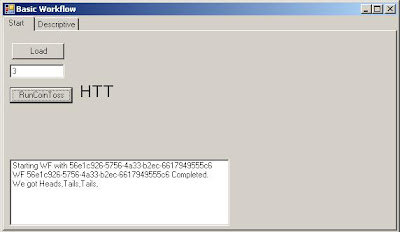
On Mike Breeze blog I noticed two posted about last TechEd08 about building RFID solutions with BizTalk and Getting Workflows Running and talking in Your Applications. First one I could not much with since I do not have an environment with BizTalk running together with RFID the another one was for me more interesting. The slide deck and code could be downloaded. I tried out the examples on my VS2008 virtual environment. The samples are around the presentation demoing different aspects of hosting and running workflows (WCF based, .NET 3.5, Tracking, FilePersistence, Obtaining Metadata etc). I downloaded the samples, unzipped them and started the solution. I did get an error concerning Microsoft Office; on this virtual machine no office was installed so that explains the error. On project called WordDesignerRehosting need Microsoft Office. I set BasicWorkflow project as startup project and started instance.

I tried out sample running a toss coin. Nice, I am going to try out the other samples/demo’s as well to see some more WF in action.
Technorati:
Windows Workflow

I tried out sample running a toss coin. Nice, I am going to try out the other samples/demo’s as well to see some more WF in action.
Technorati:
Face lift
As some of you might have noticed I have given my blog site a new look. After almost two years of blogging I got fed up with template from blogger one can standard add. So I took the liberty of taking a new one. I have chosen the frozen-age look and changed the banner to a picture of myself taken during my stay at LEAP 2008 in Redmond. It is me with mount Rainer in the back. I also left so things behind like cloud tag, what I am consuming and most of the advertisement. Well I hope you like it, at least I do since it is more vivid in my opinion.
BizTalk 24*7 BlogDoc
Saturday, September 06, 2008
BizTalk Server 2009
BizTalk Server 2009 is the new name instead of BizTalk Server 2006 R3. Does this mean that it will be a complete new version of the product of just an extension of BizTalk Server 2006 like R2? What can be expected from this version is :- Support for the latest Microsoft Platforms including Hyper-V Virtualization, Visual Studios 2008, .Net 3.5, SQL 2008, and Windows Server 2008.
- Enhancements to SOA and Web Services, B2B Integration, and Developer Productivity.
- Additional enhancements driven by customer feedback.
Many people including myself have blogged about R3 or mentioned it somewhere. Steve Martin mentioned in his blog post yesterday that it will be a major version change. That is a bit different than announcement made early this year (April 2008), where the product would take advantage of 08 wave of products (OS 2008, .NET 3.5, Visual Studio 2008, SQL Server 2008) and deliver customer requested capabilities like:
- New web service registry capabilities with support for UDDI version 3.0
- Service enablement of applications (through new and enhanced adapters for LOB applications, databases, and legacy/host systems)
- Service enablement of "edge" devices through BizTalk RFID Mobile
- Enhanced interoperability and connectivity support for industry protocols (such as SWIFT and EDI)
- SOA patterns and practices guidance.
One can see similarities in list of capabilities, but what are additional enhancement driven by customer feedback. The same as mentioned for R3 or others. CTP are already released to selected customers and next CTP update will be Q4 of this year. Hopefully I can my hands on it so I can have a look. More information can be found at his post. At BizTalk Server website item ‘Where are we going’ there is more around this coming release. Finally there is a new logo as well.
Technorati:
Friday, September 05, 2008
PDC 2008 I can't wait
Today I stumbled over a blog by Marcel Fernee from Microsoft The Netherlands. I know him through projects I have done with customers and he helped me out a couple of times. I read his post about coming PDC. As a employee of Microsoft he went to their internal TechReady Conference in Seattle. He mentions that there will be a lot announcements from Microsoft. In his posts two code names where mentioned; Red Dog and Zurich. So I googled around a bit and found some information. Red Dog is a cloud utility and will be a competitor to Google's App Engine . Zurich is an initiative to extend Microsoft’s .NET application development technologies to the Internet ‘cloud'. Having read this I am really anxious to hear about during the PDC end of October.
Technorati:
PDC 2008
Technorati:
Thursday, September 04, 2008
Microsoft ESB and OSLO
Today I browse around some RSS feeds about BizTalk and came across two interesting things. First I interesting thing I found was a discussion on MSDN about ESB Guidance for BizTalk Server. I recently wrote an article together with Wouter Goedvriend about ESB Guidance package to be publish hopefully in Dutch Software Release Magazine coming fall. We posted a question: Is Enterprise Service Bus (ESB) a well known (super)pattern and if so in which scenario's does one apply it? On linked-in we got a couple of answers back. These were as follows:
"My understanding of the concept of an ESB (Enterprise Service Bus) is that it is a way to bring all of the technologies within a company, entity, or enterprise together. Depending on the magnitude of what that could encompass, it *could* mean a simple product that "maps" everything together.Usually, though, it is a way -- and therefore, an architectural pattern as you stated -- to bring all of the different softwares, databases, and knowledge within an entity together to allow mutual communication..."
"...ESB by itself doesn't provide any business value as explained very nicely by Bobby Woolf, it is a capabaility you must have to implement an SOA strategy. Especially when services you are enabling are over many disparate legacy systems..."
"The most important concept is that an ESB is a architecture pattern (mostly related with SOA technologies) and not a tool.”
"As a bus, the ESB is primarily a routing pattern, although, most of the market is selling it as a messaging exchange pattern. The concept of the bus is an abstraction for invocation of services based on either content or endpoint semantics. The value is mediation of service invocation interfaces from the business process, thus simplifying their creation..."
If you talk about capabilities we like Richard Seroter/Leonid Ganeline states in this discussion are:
• Message transformation
• Message routing (often on subject/itinerary or content)
• Quality of service and reliable delivery
• Message validation
• Environment/application adapters
• Support for a variety of communication patterns (pub/sub, sync/async, etc)
• Service aggregation
• Rich web services support
• Unified error handling
• Unified message format
And most vendors offer these capabilities even Microsoft with their ESB Guidance Package. Which is a toolset to be used to implement a full ESB solution or take some components out of this package like error management. But I also agree with Richard that ‘full ESB solution’ is open to interpretation. Very interesting discussion and it probably will go on for a long time. I do think that providing guidance like Microsoft by giving a toolset for implementing an ESB or just extended capabilities of BizTalk Server is a good thing. By providing this package makes product evolve to a platform to create different solutions (based on business need and criteria) with different deployments with the product.
The other interesting thing I found was bloggers guide for Oslo by Alan Smith. It has not much content yet, but that will surely change as PDC starts. Read this interview to learn more. That’s it, now I going to listen to Metallica’s new album ‘Death Magnetic’ again.
Technorati:
Microsoft ESB
Microsoft OSLO
"My understanding of the concept of an ESB (Enterprise Service Bus) is that it is a way to bring all of the technologies within a company, entity, or enterprise together. Depending on the magnitude of what that could encompass, it *could* mean a simple product that "maps" everything together.Usually, though, it is a way -- and therefore, an architectural pattern as you stated -- to bring all of the different softwares, databases, and knowledge within an entity together to allow mutual communication..."
"...ESB by itself doesn't provide any business value as explained very nicely by Bobby Woolf, it is a capabaility you must have to implement an SOA strategy. Especially when services you are enabling are over many disparate legacy systems..."
"The most important concept is that an ESB is a architecture pattern (mostly related with SOA technologies) and not a tool.”
"As a bus, the ESB is primarily a routing pattern, although, most of the market is selling it as a messaging exchange pattern. The concept of the bus is an abstraction for invocation of services based on either content or endpoint semantics. The value is mediation of service invocation interfaces from the business process, thus simplifying their creation..."
If you talk about capabilities we like Richard Seroter/Leonid Ganeline states in this discussion are:
• Message transformation
• Message routing (often on subject/itinerary or content)
• Quality of service and reliable delivery
• Message validation
• Environment/application adapters
• Support for a variety of communication patterns (pub/sub, sync/async, etc)
• Service aggregation
• Rich web services support
• Unified error handling
• Unified message format
And most vendors offer these capabilities even Microsoft with their ESB Guidance Package. Which is a toolset to be used to implement a full ESB solution or take some components out of this package like error management. But I also agree with Richard that ‘full ESB solution’ is open to interpretation. Very interesting discussion and it probably will go on for a long time. I do think that providing guidance like Microsoft by giving a toolset for implementing an ESB or just extended capabilities of BizTalk Server is a good thing. By providing this package makes product evolve to a platform to create different solutions (based on business need and criteria) with different deployments with the product.
The other interesting thing I found was bloggers guide for Oslo by Alan Smith. It has not much content yet, but that will surely change as PDC starts. Read this interview to learn more. That’s it, now I going to listen to Metallica’s new album ‘Death Magnetic’ again.
Technorati:
High Performance Learning Environment for BizTalk Part IVa - Developing Solutions
A couple of weeks ago Jean-Paul Smit released BizTalk Software Factory V1.5. I myself want to start with next part of my High Performance Learning Environment for BizTalk i.e. development. This factory is useful if you want to start developing BizTalk solutions. In a previous post I already described the previous version of the BizTalk Software Factory. This version has improved a lot and there are features in them like unit tests. Besides developing your solutions testing is very important to eventually end up with a robust solution. I downloaded new BizTalk Server Factory and installed it on my virtual machine (I first had to uninstall the previous version). I then opened up VS2005 and started a new project; type BizTalk Software Factory Solution. I created a snk file and created a BizTalk Solution with all options. I noticed that a couple of solutions were generated and even unit tests.
+First+Application.jpg)
I then found out biztunit and nunit were not properly installed or installed at all. So I had to fix that. This release of BizTalk Server Factory BizUnit 2.2 and nUnit 2.4.7 are needed, so I download and installed them. Note here that you have to clearly monitor your environment about versions of tooling sitting on your machine. Finally I build the complete solution with all the projects and it succeeded. Now of course the fun starts by developing a solution, deploy it and test it. In following posts I will go through the complete process.
Technorati:
BizTalk Software Factory
BizTalk Server 2006 R2
+First+Application.jpg)
I then found out biztunit and nunit were not properly installed or installed at all. So I had to fix that. This release of BizTalk Server Factory BizUnit 2.2 and nUnit 2.4.7 are needed, so I download and installed them. Note here that you have to clearly monitor your environment about versions of tooling sitting on your machine. Finally I build the complete solution with all the projects and it succeeded. Now of course the fun starts by developing a solution, deploy it and test it. In following posts I will go through the complete process.
Technorati:
Subscribe to:
Posts (Atom)